
Saving and planning for retirement are top priorities for more than eight in 10 public sector workers – yet only 41% say they are on track for achieving the retirement they want. And while 73% expect to fund retirement with their retirement savings plans, only one in four have clear goals on how much they need to save.1
Part of the challenge employees are facing is the need to balance competing financial goals and obligations – such as figuring out how to save and invest for the future while managing current priorities, like paying down student loans and credit card debt, saving for emergencies, and managing day-to-day expenses.
This is further compounded by the day-to-day demands of life, which can leave people feeling overwhelmed and unable to take the time to sit down, analyze their financial situation, and construct a comprehensive plan for their future, resulting in financial inertia.
The good news? Employers are uniquely positioned to help employees take action by integrating access to financial professionals as part of the advice and resources offered through their retirement plan. This can help reduce the burden on employees while demonstrating a strong commitment to their long-term financial success. It can help alleviate employee stress and potentially boost productivity – and serve as a powerful differentiator in attracting and retaining top talent.
There are a number of barriers that keep employees from seeking professional advice on their own – the top three reasons cited are worries about cost, feeling intimidated, and not knowing how to find the right person.2 Offering access to a financial professional through the workplace helps address these barriers by making advice accessible regardless of net worth and delivering valuable information and services.
More specifically, financial professionals provide:
- Personalized financial coaching and guidance
Given everyone’s financial situation is unique, it’s important for employees to get help with setting personal financial goals, creating tailored budgets to meet current and future needs, and developing strategies for debt reduction and wealth accumulation, in a one-to-one setting.
- Financial education and literacy
Workshops and webinars on a variety of topics can address broad employee financial needs in an easily accessible format, including live sessions and on-demand recordings.
- Investment guidance and retirement planning support
Employees can benefit from education and advice that simplifies investment concepts and explains portfolio structure, asset allocation, and investment options in their retirement plan. They can also benefit from getting assistance with projecting retirement income needs and creating a plan to meet retirement goals.
- Holistic planning
Looking at an employee’s entire financial picture can help them understand how financial decisions affect each other and provide a cohesive strategy and sustainable approach for financial well-being.
- Targeted support by lifestage and demographic
Addressing varying financial priorities can meet employees’ needs at different stages in their life, starting with early career (such as Gen Zers and younger millennials), to mid-career (older millennials and Gen Xers), and all the way to pre-retirement and retirement stages (such as older Gen Xers and baby boomers).
Financial professionals provide the structure, support and nudges that may be necessary to transform good intention into consistent and healthy financial habits.
Here’s how:
- Driving engagement
Working with a financial professional helps improve financial confidence and supports plan engagement. More than half (52%) of public sector workers would feel more confident about retirement if they had a financial professional helping them.3
- Overcoming inertia
The real or perceived complexity of financial topics can prevent individuals from taking action: About a third of Americans (34%) say they are novices when it comes to their knowledge about planning and saving for retirement.4 A financial professional can act as a navigator, creating a clear, step-by-step plan that makes seemingly daunting tasks feel manageable.
- Taking emotion out of investing
Market volatility, economic downturns, employment changes, or even current events can lead to knee-jerk investment decisions. The key is to make decisions based on a well thought out long-term strategy and avoid reacting emotionally – which can be challenging.
- Reducing stress
Seventy-three percent of Americans are stressed about their personal finances, with 38% saying they are very stressed.5 Worries about money can lead to elevated anxiety levels, affecting health and productivity. Having a plan to address financial concerns with the guidance of a professional can help alleviate stress and even improve employee confidence in their ability to manage their financial lives.
While only about one in four (23%) public sector workers say they’ve worked with a financial professional, 51% say it is a priority to do so – with 21% saying it is a high priority. And advice improves confidence – 78% of workers who work with one also say it makes them more confident in their retirement.6
Employers have a unique opportunity to create this connection – and for many workers, it may be their best option for getting professional guidance and having a concrete plan for financial well-being.
Benefits of workplace financial professionals
- All employees are eligible
No minimum asset or income requirements.
- One-on-one
Personalized meetings either online or in person.
- Convenient meeting times
Flexibility to schedule within or outside of working hours.
- Guidance and advice
Access to experienced advisors who are licensed to provide financial education and advice as part of an employee benefits package.
- It’s not a one-time thing
Employees can schedule multiple meetings in a year to track progress on financial goals, address life events, or get help on different matters.
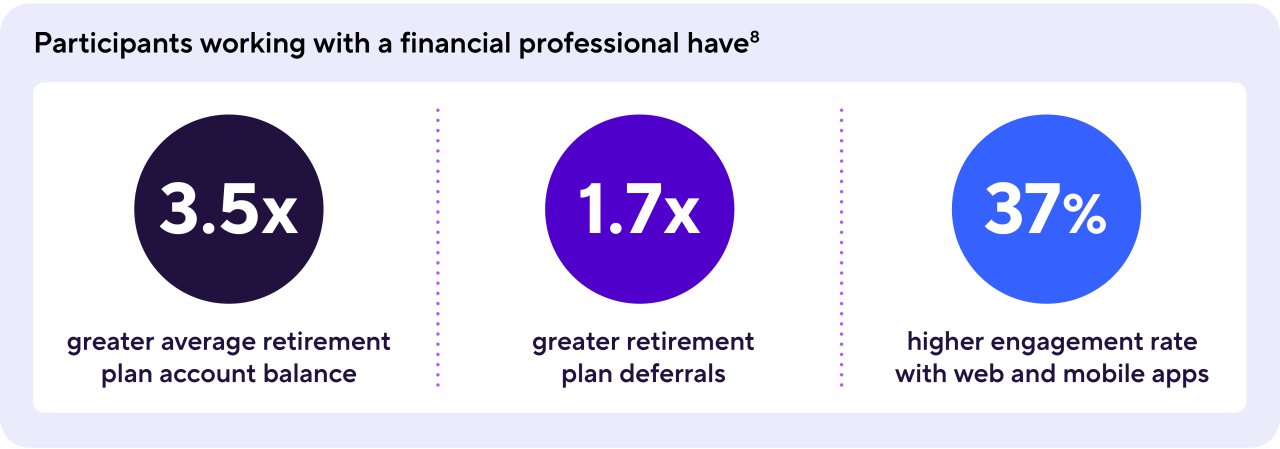
Generally, plan sponsors who provide employees with access to trusted financial professionals can expect to:
- Improve retirement plan metrics such as enrollment numbers, deferral rates, and asset diversification.
- Raise productivity by reducing employee financial stress associated with retirement and financial matters.
- Support employee retention and acquisition efforts by highlighting the value of your organization’s retirement plan benefits.
- Contribute to timely retirements through improved employee financial well-being and retirement readiness.
Americans' confidence in their financial planning abilities

Source: Corebridge Financial, Living and funding longer lives, 2025.
As you continually look for ways to improve employee retirement outcomes, consider offering access to financial professionals through your retirement plan. If you already offer access, encourage your employees to take advantage of these valuable services. You may even be in the position to offer incentives such as wellness points to nudge your employees to meet with a financial professional.
It’s important to use all the resources available through your retirement plan provider to support your employees and make a significant difference in their lives.
Partner with your retirement plan provider to offer a successful advice program
Your plan provider – with your feedback and approval – can take the lead in putting together a successful advice program which includes:
- Assessing your retirement plan’s advice and guidance offering
Taking inventory of the available educational and advisory resources helps ensure your employees have access to a diverse range of support and resources. It also takes into consideration how they prefer to access and receive financial advice.
- Communicating the value of personalized financial advice
It’s important for your employees to understand how advice and guidance can help them reach their financial goals, and to be comfortable with the advice process.
- Making it easy
Your employees are juggling a lot in their lives and other tasks may take priority over addressing financial concerns and planning. The key is to make educational content, newsletters, webinars, enrollment meetings, or the ability to schedule a meeting with a financial professional easily accessible to your employees.
- Tracking, measuring, and improving
Evaluating the employee and plan level impact of your plan’s advisory services can help determine what’s working best and how to improve your advice offering.